US cups and metric: converting recipe measurements both ways
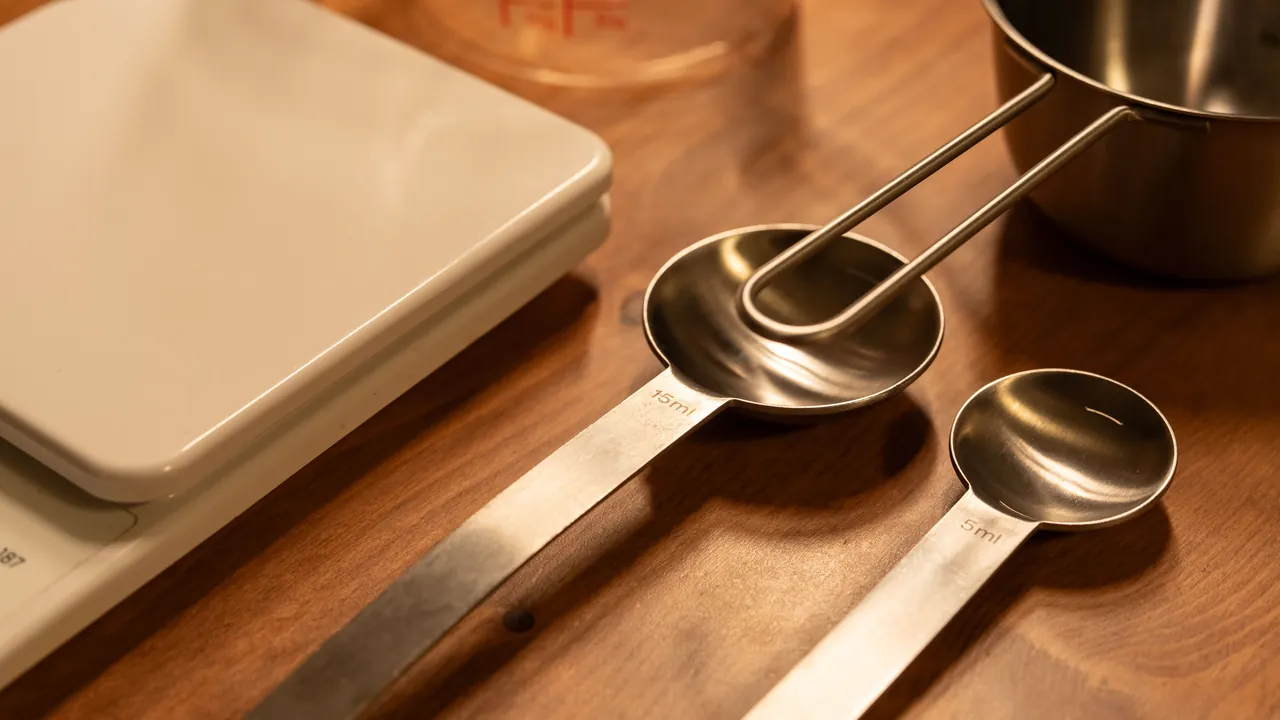
A recipe may give you U.S. cups, ounces and degrees Fahrenheit, or grams, millilitres and degrees Celsius. The words look simple, and the units do not line up with each other. This guide converts in both directions, with the same figures. They were checked on 19.10.2026 in open sources: the U.S. National Institute of Standards and Technology, Hebrew conversion sites and an encyclopedic entry on the cup. No new number is added here: each pair is the same pair, read from either side.
A cup is not always the same cup
According to the U.S. National Institute of Standards and Technology, a U.S. customary cup is about 236.6 ml, a tablespoon about 14.8 ml and a teaspoon about 4.9 ml. The other way: about 236.6 ml is 1 U.S. customary cup, about 14.8 ml is 1 tablespoon and about 4.9 ml is 1 teaspoon. Hebrew conversion sites round to a cup of 240 ml, a tablespoon of 15 ml and a teaspoon of 5 ml; the other way, 240 ml is that rounded cup, 15 ml is 1 tablespoon and 5 ml is 1 teaspoon. According to a U.S. Food and Drug Administration (FDA) guide, in U.S. nutrition labeling a cup is 240 ml, so 240 ml is 1 cup on a U.S. nutrition label. In Australia, according to the superseded standard AS 1325-1972, a metric cup is 250 ml and a tablespoon is 20 ml; the other way, 250 ml is 1 metric cup and 20 ml is 1 tablespoon in that standard. According to the encyclopedic entry, a U.S. cup is also 8 fluid ounces, 16 tablespoons or 48 teaspoons, so 8 fluid ounces, 16 tablespoons or 48 teaspoons are 1 U.S. cup. The differences between the cups are small, but in a sensitive recipe it is worth knowing which country's cup you have.
An ounce can be weight or volume
An ounce is a unit of weight of about 28.35 grams, and a fluid ounce is a unit of volume of about 29.57 ml. A pound is about 453.6 grams. The other way: about 28.35 grams is 1 ounce of weight, about 29.57 ml is 1 fluid ounce, and about 453.6 grams is 1 pound. One of the conversion sites explains that in an American recipe an ounce next to a dry or solid ingredient, such as flour, chocolate or cheese, is weight, and a fluid ounce fits water and milk.
An example of ours, in both directions. The recipe asks for 8 fluid ounces of milk, 4 ounces of butter and one pound of flour. The arithmetic:
- 8 fluid ounces × 29.57 is about 237 ml of milk. About 237 ml of milk is 8 fluid ounces.
- 4 ounces × 28.35 is about 113 grams of butter. About 113 grams of butter is 4 ounces.
- A pound of flour is about 454 grams. About 454 grams of flour is 1 pound.
Ingredients that arrive in odd units
- A "stick" of butter in an American recipe is, according to one of the conversion sites, about 113 grams. The other way, about 113 grams of butter is one U.S. stick.
- Yeast: according to two Hebrew conversion sites, 1 gram of dry yeast equals 3 grams of fresh yeast. The other way, 3 grams of fresh yeast equals 1 gram of dry yeast.
If a recipe mentions a unit you do not know, do not guess: check it in another source before you measure.
Fahrenheit and Celsius
An American recipe may give a temperature in degrees Fahrenheit. The formula the U.S. National Institute of Standards and Technology publishes: subtract 32 and divide by 1.8. The same pairs, both ways:
- 350 degrees Fahrenheit is about 176.7 degrees Celsius. About 176.7 degrees Celsius is 350 degrees Fahrenheit.
- 400 degrees Fahrenheit is about 204.4 degrees Celsius. About 204.4 degrees Celsius is 400 degrees Fahrenheit.
- 425 degrees Fahrenheit is about 218.3 degrees Celsius. About 218.3 degrees Celsius is 425 degrees Fahrenheit.
- The other way, as published: 180 degrees Celsius is 356 degrees Fahrenheit, so 356 degrees Fahrenheit is 180 degrees Celsius.
These are mathematical conversions. The temperature you actually use is set by the recipe and by your oven, so follow what the recipe says and check the food.
Cups and grams: it depends on the ingredient
When the recipe is in cups and you prefer grams, or the recipe is in grams and you only have cups, the conversion depends on the ingredient, and the sources do not agree. A cup of white flour runs from 120 to 140 grams, so 120 to 140 grams of white flour is about one cup, and one source explains that the amount changes with sifting, packing and the type of flour. That is why we do not set a single value: when precision matters, weigh. Some sources recommend a kitchen scale for sensitive baking.
Ingredient names: check before you buy
We did not include a word list here, because we did not check one against a source. What remains is a way of working: when an ingredient's name is unclear, in either direction, check it in a dictionary or another source before you add it to the shopping list. A translation, by hand or automatic, is worth reading with a critical eye.
When you convert it yourself
Write the original unit and the new unit next to every quantity, for example "8 fluid ounces = about 237 ml" and, the other way, "about 237 ml = 8 fluid ounces". Then you can go back and check, and if something comes out odd, you can see at once where the conversion was made.
And where does KitchenAppes come in?
According to the KitchenAppes homepage, you can read recipes in Hebrew, English and Russian. If a recipe was written in another language, the app can translate it, and the ingredient units match your language. The page does not say how that matching is done or how accurate it is, so you go over the quantities yourself before you cook. After you find a recipe, you can add the ingredients to the shopping list and save it in your cookbook. You can start with the community recipes on KitchenAppes, and read more about us.
KitchenAppes
Download the app