An oven recipe in an air fryer: how to follow a KitchenAppes step without inventing a time
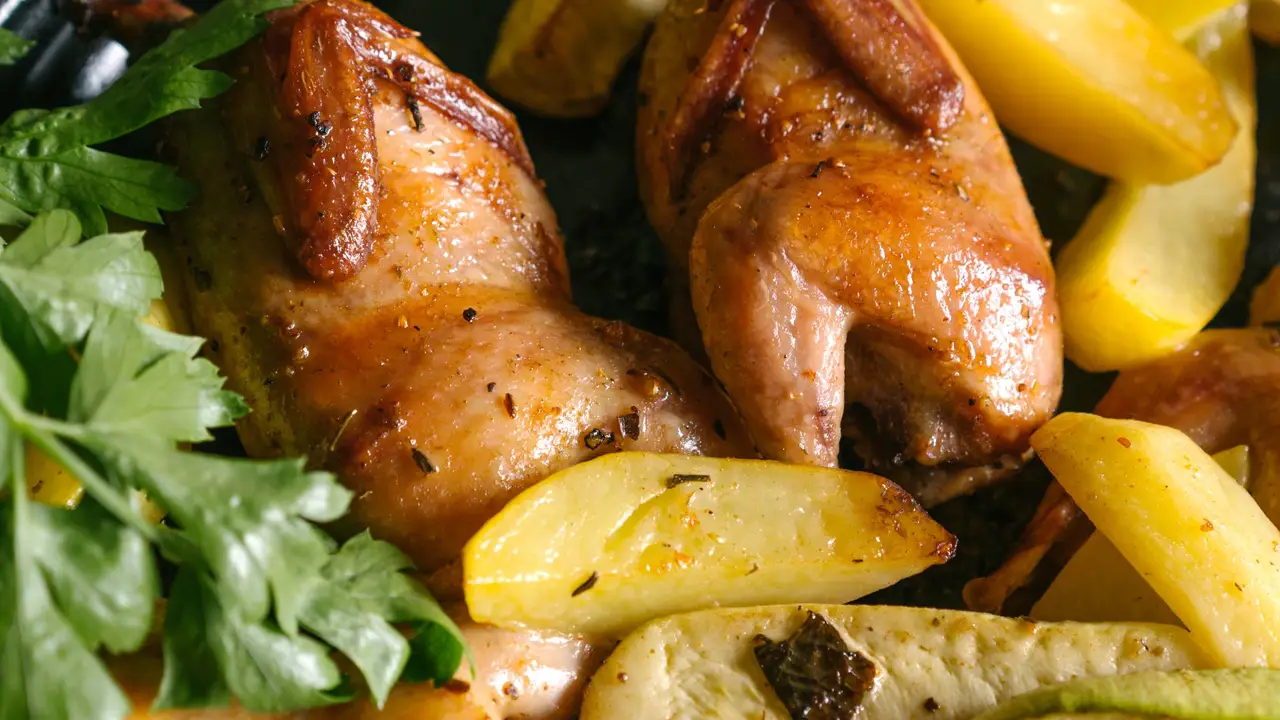
Photo: ArtHouse Studio
An oven recipe states a temperature and a time for a tray. An air-fryer basket is a small box with a fan. You cannot copy both numbers as they are and expect the same dish, and you also cannot invent "take off twenty percent" if the maker did not write it. On the pages checked on 20 October 2026, neither Ninja nor Breville publishes a general conversion formula from every oven recipe to every basket. This article is a sequence of checks, not a table of minutes.
The recipe first, then the appliance
Open the recipe in cooking mode. According to the KitchenAppes homepage, the mode keeps the screen on and shows one step at a time, and timers start directly from the step that needs them. From the step, write down the oven temperature and the time, and the pan size if it is written. If the degrees are Fahrenheit and the appliance or your habit is Celsius, stop at converting the measurements before you continue. Converting 350 Fahrenheit is not a shorter time. It is only the same temperature in another language.
Then ask whether the food fits in one layer. On the Ninja FlexBasket FAQ Ninja asks for an even layer with no overlap, and a shake during cooking, so the browning is even. The DZ071 product page talks about two baskets of 3.5 quarts or one basket of 7, and the FAQ says 3 quarts per basket. That gap is written in the article on the model. Here it is enough that a full oven tray of chicken and vegetables usually will not fit in one basket without a pile. A pile, according to that Ninja answer, needs turning. If you cannot turn it, it is not the same dish, and there is no point chasing the same time.
Preheat is not one rule
Ninja writes on that same FAQ that preheating is not needed. In the Breville manual for the BOV950 the air-fry row is marked with a preheat. Someone moving a recipe "into a preheated oven" onto a Ninja does not add the preheat minutes of the home oven, because its page says there is no such step. Someone moving it onto a Joule oven does not delete the preheat, because the manual marks it. That is the practical difference, and it comes from the pages, not from an internet rule.
The range matters just as much. On the Ninja, air fry is 300 to 400 degrees Fahrenheit, default 390. On the Breville, 300 to 480, default 400 for 18 minutes, up to one hour. An oven recipe at 220 Celsius, which is around 430 Fahrenheit, fits Breville's range and does not fit the Ninja air-fry range that appears on the FAQ. In that case you do not "get close." Either you choose another mode if it has a suitable range, such as roast on the Ninja up to 400 only, which still does not reach 430, or you leave the dish in the oven. The Joule oven reaches 480 Fahrenheit on bake. That is not a reason to assume every basket gets there.
Time: check early, do not invent a percentage
Ninja puts in the DZ071 box, according to the product page, 15 recipes and charts. If your dish is similar to a row in its chart, that is a starting point from the maker. If it is not, the pages we read have no fixed multiplier. Ninja's instruction when the food does not brown: extend the time, or add oil by the tablespoon, and keep turning. When it burns: check in the middle and take it out when the colour is right, do not wait for the end of the timer. Oil is not required, and the start it suggests is one tablespoon. Oils with a low smoke point will smoke. Its examples of a higher oil are avocado and olive.
The Ninja basket does not stop when you pull it out. Press Start/Pause before you open it. Someone who peeks "just for a moment" without stopping leaves the fan running on a basket that is not in place. That is a line from the page, and it is worth a note inside the saved recipe.
Two zones share the power, so Ninja says cooking in both can take longer. A recipe written for one tray does not become two recipes just because there is a divider. Smart Finish is meant for two foods with different times that should finish together. If the recipe has only one time, there is nothing to sync.
An example without an invented number: chicken and potatoes from the oven
Take a recipe that says a pan, 200 degrees Celsius, one hour, chicken and vegetables. Do not subtract a percentage. Walk the list.
First the conversion, if you need it. 200 Celsius is not a number the basket displays if it is in Fahrenheit. The conversion guide gives the method. After you have a number in Fahrenheit, compare it with the range. 200 Celsius is above 400 Fahrenheit. Ninja's air fry, on the FAQ, stops at 400. So either the dish comes down into the range and it is no longer the same temperature, or it moves to the Joule oven, whose bake and air fry reach 480, or it stays in the home oven. Three honest options. There is no fourth one named "about."
Then the volume. A family pan is not a basket of 3 or 3.5 quarts. If you split into two zones, each zone gets one layer, and both zones on the Ninja can take longer because the power is split. Smart Finish is relevant only if the chicken and the potatoes have different times and you want them to finish together. If both have the same time, Match Cook copies one setting. If the quantity is still a pile, go back to the oven.
Preheat: an oven recipe usually heats the oven first. On the Ninja the page says you do not need to. Do not add the oven's preheat minutes to the basket's timer, and do not delete them on the Breville, because there the row is marked yes. The timer in KitchenAppes comes from the recipe step. If you changed the method, change the saved step, so the next timer does not repeat a preheated oven when there is no such step.
Oil: Ninja suggests starting with a tablespoon, not "with no oil at all" and not "the same as in the pan." If the recipe is already generous with oil on the potatoes, do not add a tablespoon automatically. Look. If it is pale, more time or another tablespoon, according to its page. If it is dark early, take it out. That is the whole algorithm on the pages. It is longer than a slogan, and it does not require a number you have not seen.
At the end, write on the copy: "Ninja DZ071, one zone, did not go past 400 Fahrenheit, checked in the middle, the basket does not stop by itself." Or "stayed in the oven because it did not fit." Both results are legitimate. Only an invented result, with a percentage that was not measured, poisons the recipe for next time.
If the house also has a pressure cooker, do not move the same pan into it just because it is available. Chicken and potatoes that need browning do not get it from pressure. The Duo sautés on the bottom before the lock, and that does not replace a tray. And if the goal is even chicken with no crust, that is already a sous-vide conversation, not a basket conversation. Choose one tool for this step, and write it down. Mixing three appliances in the same step, when none of them was published for that, is how a recipe becomes unreadable.
What you write back into the recipe
After the dish came out the way you wanted, the original recipe still says "oven." If you leave it that way, next time you start from the beginning. In KitchenAppes you can save a copy and write in the step what you checked: which model, which mode, which temperature is allowed according to its page, and when you looked. Do not write a shortening percentage you did not measure. Write the minutes that came out for you, on the quantity that fit in one layer.
The shopping list is built before cooking, not from the leftovers. A weekly menu and what is in the fridge sit before the question of whether to take the basket out at all. If the dish is bigger than the basket, it stays in the oven, or it splits into two batches, and each batch is a separate time. A second batch is not "another ten minutes on the same timer." It is another cycle, because the basket is already hot and the first batch is already out.
A scale helps when the recipe is in cups and the basket is sensitive to quantity. How many grams in a cup and the ESN00 scale are about the measurement, not about the heat. A thermometer helps when the recipe says "until it is done" and meat needs a number. MEATER Pro measures inside and ambient, within its limits, and the basket measures the air it blows. Two numbers. Do not swap one for the other.
You can browse the community recipes on KitchenAppes and read more about us. How to choose between a basket, a pressure cooker, a sous-vide wand and a countertop oven, before you open the recipe, is written in which appliance for dinner.
Questions
By what percentage should you shorten an oven recipe?
We did not find, on the Ninja or Breville pages that were checked, a general formula like that. Check that the temperature fits the mode's range, that the food is in one layer, and look before the end of the original time.
Do you need to preheat the basket?
On the Ninja FlexBasket, the FAQ says no. On the Breville BOV950, the manual marks a preheat for air fry. It depends on the model on the counter.
What if 220 degrees does not exist on the basket?
Do not lower it quietly and hope. If the mode's range ends lower, this dish does not work in that mode. On the Ninja, air fry ends at 400 Fahrenheit. On the Breville it continues to 480.
Does the basket stop by itself when you open it?
Not on the Ninja, according to the FAQ. Press pause before you pull it out. Write that in the step, so you do not rely on memory.
Does KitchenAppes run the basket?
No. It shows the step and the recipe timer. You set the mode and the temperature on the appliance, inside the range the maker published.
KitchenAppes
Download the app