Which appliance for dinner: air fryer, pressure cooker, sous vide or a countertop oven
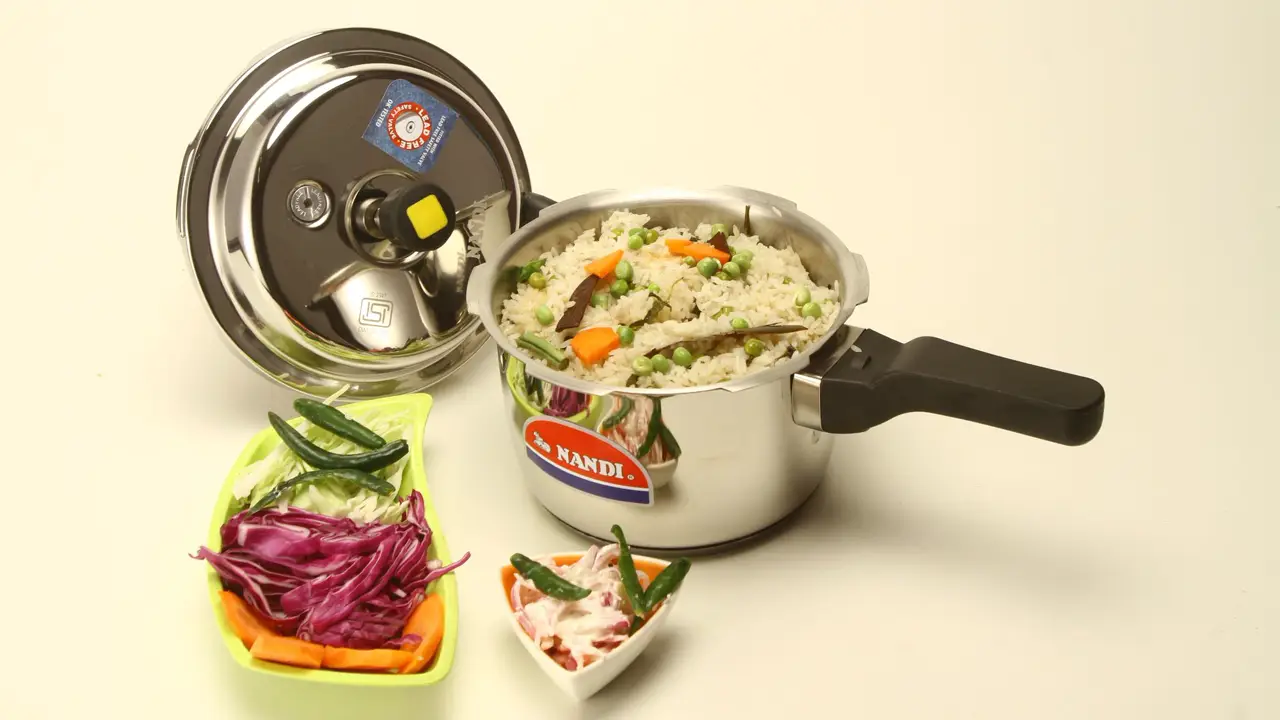
Photo: Milton Das
The question is not "what is the smartest." The question is what the dish needs: hot air in a small box, pressure, water at a steady temperature, or a large chamber with heating elements. The six articles written on 20 October 2026 check a model against a maker's page. Here they are arranged by the meal, with the prices that were visible that day, and without a price that was not on the page.
A crisp dish, for two or for four
An air-fry basket fits when the food goes in as a layer and the goal is browning. The Ninja Foodi FlexBasket DZ071 splits a 7-quart basket into two sides, or leaves it whole. The product page says 3.5 quarts a side, the FAQ says 3, and both are official. Air fry there ends at 400 degrees Fahrenheit. The power is 1,690 watts at 120 volts. The price on the US site on 20 October 2026 was 199.99 dollars. There is no app in the description on that page. 15 recipes come in the box.
If the dish is a 13-inch pizza, a 14-pound turkey, toast, or a 9-by-13 pan, that basket is not the tool. Breville's Joule oven, the BOV950, publishes exactly those capacities, with 1,800 watts, 13 presets on the machine and three more in the app. Its air fry reaches 480 degrees Fahrenheit, up to one hour, with a preheat. The price that day: 499.95 dollars in the United States, 799.99 Canadian dollars in Canada. The dimensions are not the same on the two pages. Both appliances are 120 volts. We did not find a 230-volt model for them, so there is no approval here for an Israeli socket.
How not to copy an oven time into a basket without a formula the maker did not give is written in an oven recipe in an air fryer.
A stew, beans, yogurt, rice
Here the basket loses to volume and to pressure. The Instant Pot Duo at 6 quarts gives pressure, slow cook, sauté, steam, rice, yogurt and keep warm, 13 programs, 1,000 watts, 120 volts. The Duo Plus adds sous vide and sterilize, and reaches 15 programs. Neither page had a price on the day we checked. The warranty does not cover use outside the United States and Canada. Wi-Fi does not appear on them. In Instant Pot's comparison table, a Wi-Fi remote is attached to the Pro Max, whose product page we did not open.
Quick release is forbidden there for a thick stew, for chili, for pasta and for beans. That is a safety line, not a style tip. Someone cooking beans lets the pressure come down by itself.
Sous vide written on the Duo Plus is not a wand. For an accuracy of a tenth of a degree and a flow of 8 or 12 litres a minute, you go to Anova.
A cut that should be the same from the edge to the centre
The Anova Precision Cooker, Cooker 3.0 and Pro clamp onto a pot. 1,000, 1,100 and 1,200 watts, in that order. The accuracy in the table is 0.1 degrees Celsius on the first two, and 0.05 on the Pro. On 20 October 2026 the sale price of the base and of the Pro was 199 dollars, against a regular price of 219 and of 459. The Cooker 3.0 stood at 229. The product pages say 0 to 92 degrees. A support article, without naming the newer models, says a hold from 25 to 99, with no boiling. The Pro and the base ask for 2.4 gigahertz. The 3.0 is written as dual band. The browning is in a pan afterwards, not in the wand.
If what is missing is not the water temperature but the meat temperature, the wand is not enough. MEATER Pro measures inside up to 105 degrees Celsius and ambient up to 550, with five sensors, on Bluetooth and not on Wi-Fi. In the shop, that day: 99.99 dollars for the Pro, 179.99 for the Duo with Wi-Fi and two probes, 349.99 for the XL with four. The range on the product page and in the support guide is not told as the same number. Do not close that in one sentence.
Before you buy, three dry checks
The electrical supply. Every appliance detailed here with a full specification is 120 volts, except the Etekcity scale, which is not a cooking appliance. 15 amps on the Ninja, about 14 on its FAQ, are a conversation about an American breaker. Someone who has not checked 230 volts should not discover it after the box arrives.
The size. On the Ninja, two dimension tables are not the same. On Breville, the American measurement and the Canadian one are not the same. On Instant Pot, the length and width labels swap between the Duo and the Duo Plus. Measure the space in the cupboard, then the figure from the shop, not an average from an article.
The account. The Ninja DZ071 does not describe an app. MEATER Pro is Bluetooth. Anova and Breville do talk about an app. Instant Pot Duo does not. Pro Max, in the table only, does. What actually needs Wi-Fi stays the question before you open an account, not after.
The scale is a separate question, before the heat. The ESN00 reaches 5 kilograms in steps of 1 gram, at 39.99 dollars on the day we checked, with a barcode scanner limited to the United States. The ESN90, at 18.99 dollars, goes down to 0.1 gram under a kilogram. A cup that has not yet been converted to grams stays a cup, even with Bluetooth. That is how many grams in a cup.
One week, without buying everything
Suppose an ordinary week, without inventing cooking times. On the first day, two pieces of chicken and a vegetable. If they fit in one layer, the Ninja basket is enough, inside 400 Fahrenheit. If it is a full pan for eight, a Breville oven or the oven in the wall. On the second day, beans or chickpeas. Here the basket does not help, and the Anova wand does not cook dry legumes under pressure. The Duo does, with a natural pressure release, not a quick one, according to the warning about beans. On the third day, a steak you want at the same doneness through the thickness. That is the wand, and then a pan. The MEATER probe goes in if the cut is thick enough for the notch. On the fourth day, leftovers. Ninja calls it Reheat, 300 to 400 Fahrenheit. Breville calls it Reheat with a wider range in the manual. Do not heat leftovers in a closed pressure cooker just because it is on the counter. On the fifth day, soup. The pot, or simply a pot on the hob, or a bowl that cooks if you already own one of the machines from the earlier series. Do not buy a Pro Max for one soup.
That week uses two tools at most, plus a scale if the recipes are in cups. Someone who buys five boxes because every day "requires" a different appliance is buying the list, not the meal. A weekly menu written before the shopping shows how many times you really need the basket. If the answer is once, 199.99 dollars on the US site is still money, and the oven you already have may be enough. If the answer is four times, and the tray is always full, the Breville oven at the higher price is the one that answers the volume. That count is done on your menu, not on ours.
Children in the kitchen change the choice. A pressure cooker with a steam valve is not the appliance you leave without an adult, according to the warning not to bring a face near it. A basket that gets hot on the outside, on the Ninja, needs a heat-safe surface. A wand on a pot of hot water is a pot of hot water. A connected feature does not lower the heat. Cooking mode in KitchenAppes at least holds one step on the screen, so you are not scrolling through dough with a greasy finger toward the wrong temperature. It does not lock the appliance.
And someone who cooks inside the bowl
There are machines that mix and heat in the same bowl. They were already checked against the makers' pages, and there is no point copying the tables here: Kenwood Cooking Chef XL and CookEasy+, Thermomix TM7, Bosch Cookit and Magimix Cook Expert. Someone choosing between a basket and a bowl that also chops asks whether they need browning in air or the processing of a soup. Those are not the same cavity.
Where KitchenAppes comes in, for each of the choices
None of the appliances holds the recipe you found at an aunt's house or in the community. According to the KitchenAppes homepage, cooking mode keeps the screen on and shows one step at a time, and timers start directly from the step that needs them. You set the appliance according to its range. You read the step on the recipe screen. A weekly menu decides what you cook before you choose a tool. A Shabbat shopping list comes from the menu, not from a sale card on a pot. You can browse the community recipes on KitchenAppes and read more about us.
Questions
What do you buy if the budget is one appliance?
It depends on the dish that comes back at your house. Small crisp food: the Ninja basket, 199.99 dollars on the US site on the day we checked. A large pan and toast: the Breville oven, 499.95 dollars on the same US site. A stew you can leave: Instant Pot, with no price on the page we opened. An even cut: Anova, from 199 dollars on sale up to a regular price of 459 on the Pro. No sum here is an Israeli price.
Why not "the best value"?
Because 199 dollars on the Anova Pro was a sale against 459, and 199 on the Ninja is the page price with no crossed-out price, and 199 on both of them is not the same product. Without the dish, the price does not sort them.
Duo or a circulator for sous vide?
Duo Plus names a function. Anova publishes a wand, a flow rate and an accuracy. Without a temperature range on the Instant Pot page there is no numerical comparison. Someone who needs a tenth of a degree goes to the wand.
Do you need Wi-Fi in order to cook?
No. The Ninja DZ071 does not describe a network. The Duo does not describe a network. The Pro thermometer works on Bluetooth. An app is an extra layer at Breville and at Anova, and Anova's support says you can set time and temperature without the phone as well.
How does the recipe stay tidy after the purchase?
Save it, write which mode of which model it worked on, and do not replace the original oven temperature with a number you did not measure. Cooking mode shows one step. The appliance does the heat.
KitchenAppes
Download the app